Continued from Chapter 02
On the Avis Iceland website, they offer a shuttle service to and from your hotel to the Avis Reykjavik office to pick up your car. Use it, as Avis is out of the city center and too far away to walk. A taxi ride will cost an average of €10 to get there, and it will be a challenge to get the cab driver to understand your pronunciation of Knarrarvogur Street, because you'll never be able to roll your Rrrrs enough to please an Icelander!Avis Iceland offers a wide range of vehicles but the most popular would be 4WD vehicles which can get you across river fords and terrain where normal cars can't go.As we were only driving on day excursions we chose the cheapest car that we could hire - a Nissan Micra which was ample for a family of 4, and at a frightening €130 per day which was the going rate for early August 2008.The Avis staff is a pleasant team to deal with - efficient and more than happy to provide additional info such as the best routes to get out of Reykjavik as well as to supply any maps.When signing the agreement for the car, we were asked if we would like the Additional Full Insurance option over the usual included Collision Damage Waiver (CDW) amount. We declined and all was well - until we went outside with the agent to inspect the car's condition before we drove away.Here's where renting a car in Iceland differs from any other country where we have rented cars - at least this was our experience with Avis Iceland.Take a look at this: Not a very good image because it's a big magnification from another image as I stupidly forgot to take a closer photograph at the time.This is an existing scratch on the right front corner of the car that we hired. It's about 1cm long. Above it, the yellow writing that you can just see is a numbered label. Avis Iceland labels EVERY little scratch on all their vehicles. During our inspection of the car, we were asked by the agent if we could see any that were unlabelled because we would be charged for them upon returning the vehicle. We took a good, long look around the car!It was almost enough to make us return to the office to take up the full insurance option. We're not sure if this is what Avis wants to scare people into doing, but I guess that with some people, it would work. We swallowed our fear and drove away without the additional insurance.
 The Umferðarstofa website has an excellent page on Driving in Iceland with available information in various languages. There is video and a downloadable pdf brochure with a lot of good tips and hints.Vegagerdin is the Icelandic Road Administration's website and is very useful for updated weather and road conditions. This would be invaluable if travelling to Iceland during the winter months more than in summer.Driving in Iceland is easy if you're used to left-hand drive cars and driving on the right-hand side of the road. Because it never gets truly dark in summer, you will almost never run out of daylight conditions in which to drive. Headlights must be on at all times and the open road speed limit is 90kph, although most traffic sits between 90kph and 100kph. Big, souped-up 4WDs are common in Iceland and occasionally you will get a wally who'll sit right on your bumper trying to push you off the road. Ignore the big Chevy/Toyota/Jeep/Mitsubishi grill filling your rearview mirrors and keep driving as you would normally do, or just maintain speed and pull your car over to the right as much as possible to let the idiot pass by. Luckily, my driving skills honed on Sheikh Zayed Road in Dubai gave me the cojones to deal with these monsters - even if I was driving the smallest car on the road. Road signs are clear and signage to the tourist sites is excellent.Although the €130 per day hire fee was exhorbitant for a lowest category car, it was definitely the better option for a family of 4. We worked out that over the 2 days that we had the car to travel around the south-west, we spent about €300 less than we would have spent on bus excursions to the same places, and we weren't held to ransom by having to purchase food from the tourist restaurants. Plus, we had the freedom to go and stop where and when we wanted, and to spend as much or as little time at the various tourist sites as we wished. This is important when you have 2 kids who want to go to the toilet about 10 minutes after you've left the last ones, especially when they vehemently insisted that they didn't need to go while we were standing outside them. Peeing on the side of the road seems to hold more fascination for boys than going to normal, perfectly clean toilets.As for returning the car, we did manage to give it back without any additional scratches. However, the Avis agent did take a really good look all around it. She even wiped away some mud on the guards to make sure that there was no damage underneath it. To give us some additional peace of mind, before leaving Avis I took photos of the car from all angles - just in case!Next Post: Strokkur Geyser, Gullfoss waterfall and Þingvellir National Park
Continued from Chapter 01.One thing that's great about Reykjavik is that some excursions are free for kids under 12 years of age - including bus transfers to and from Keflavik International Airport. Of course, the prices for the adults more than make up for it, but when averaging out the costs of doing things as a family, it made the charges somewhat more bearable to take.
Once out of the capital, costs for kids become scalable and depend on the area, individual tour operator whims and each transport company's fare tariffs.
We stayed in Reykjavik for 4 days and really only used it as a base for sleeping while we travelled out of the city to see other things - mainly in the south-west and within easy driving times so that we didn't succumb to killing the impatient kids by boiling them alive in the nearest thermal hotpool. As it was, within 10mins of getting in the car and before we'd even get off the Reykjavik ring-road motorway, one of them would ask how much longer it was going to take!
One thing we learned pretty quickly is that there are not many good maps of Iceland or Reykjavik to be found online. Google Earth hasn't officially mapped the country and rumour has it that the Icelandic Government wanted too much money from Google in exchange, so it hasn't been done.We found the best maps to obtain were these two freebies which we picked up in the bus depot:
 The Map of Reykjavik is self-explanatory, and the Big Map shows the roads for the whole of Iceland which is pretty much one road running all the way around the perimeter of the island, with a few roads leading into the center. What interior roads are present are only accessible by 4WD vehicles. The Icelanders love their 4WDs - the more souped-up, raised-up and big-tyred, the better they are!The most famous church on the front of the Reykjavik Map is Hallgrimskirkja which towers over the city. Long before arriving in Iceland I was looking forward to photographing it as it's an awesome structure, and I love to shoot interesting architecture. To my immense and deep disappointment, the cathedral was covered in obtrusive scaffolding as it undergoes renovation and I couldn't even bring myself to visit it. Next time.
J was still trying to keep to her running schedule as she prepares for the Berlin Marathon, so the kids and I took a walk to the waterfront and into the main tourist area of the city.The boys had fun clambering over a modern stainless steel sculpture of a Viking ship, much to the chagrin of other people wanting to take photos. I had to call them off it before the under-breath mutterings from the people around me became audible, vociferous abuse. I also used the op to get my own kid-free image!
 We then walked up from the harbour into the main area of the city.

 We spent a few minutes looking at a vast photographic wall displaying images of Icelandic children.

Walking up the main street to go grocery shopping, we passed a shop selling Arctic Wolf skins. The boys had to closely inspect a pelt hanging outside the shop which still had the wolf's paws attached to it. Fascinating in a morbid way. I was quietly pleased that both kids walked away a little subdued at the thought that a beautiful creature had died for that pelt. They're both now at an age where things like this impact upon them.

Reykjavik has a small town feel about it, and it's certainly the hub for all things touristy. The BSI Bus Terminal (the Tourist/Excursion Bus Depot) has a lot of pamphlets and brochures on the available sight-seeing tours as well as booking counters to buy tickets. The most popular trips would be the Puffin Express, Whale Watching, Blue Lagoon and the Golden Circle Route which takes in Strokkur Geyser, Gullfoss waterfall and Þingvellir (pronounced Thingvellir) National Park.
We had a day where we were vehicle-free, so we chose to hop onto a bus to the Blue Lagoon to soak in some warm water as it was very grey, cool and overcast. In Iceland, the tour buses have seatbelts for the passengers which I've always thought to be a great idea and have often wondered why countries don't make this compulsory for their tour bus operators.
The Blue Lagoon (Bláa Lónið) complex is closer to Keflavik, so the bus travels along the main Reykjavik-Keflavik highway before turning off to head for the geothermal area.
 The Blue Lagoon main bathing area
The bathing pools are fed geothermal heated seawater from the nearby power station which can be seen in the distance while bathing. The superheated 240°C water passes through the station where it is used to generate power as well as being processed for municipal use. The rest of the water (now at about 40°C) is pumped into the Blue Lagoon pools for bathers to wallow in. The water is rich in silica and sulphur and nicely warm. I'm used to mineral hotpools in New Zealand so I wasn't totally blown away by it all, but it was a great experience which we repeated on our last day in the country.
 The power plant's steamy plumes in the background
Blue Lagoon is efficiently managed. Towels and bathing costumes can be hired at extra charge, the changing rooms are modern, clean and well-maintained. Hygiene standards are strict and everyone is required to shower before entering and after exiting the pools. The nifty entry bracelets also double as electronic keys for locking and unlocking the personal storage lockers. Food and drinks can also be charged onto the bracelets and paid for upon exiting the building - a dangerous nicety given the high prices. Luckily the kids' bracelets are programmed so that they can't charge anything to them or manage their own lockers!
 The main building houses reception, spa, change areas, café and shop
As well as the main pool, there are steam rooms, and at stations around the main pool there are buckets filled with white thermal mud which we smeared over our faces and left to dry before washing off.
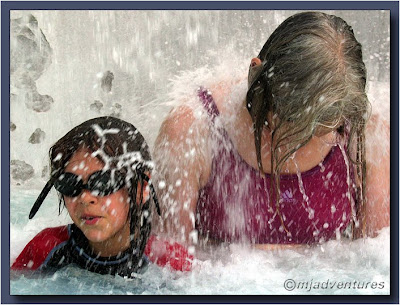 Massaged by a warm waterfall
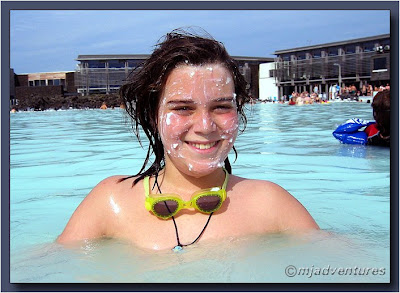 Thermal mud face mask
The Blue Lagoon also runs a spa treatment area (extra charge of course) and specialises in psoriasis treatment. There is a restaurant and café but we didn't dare go anywhere near them because of the prices. We had prepared our lunch back at the apartment and carried it in a backpack which we took out to the pool area. We were then able to snack when we felt peckish - and with the boys that was pretty much all the time until every crumb of food had been consumed!
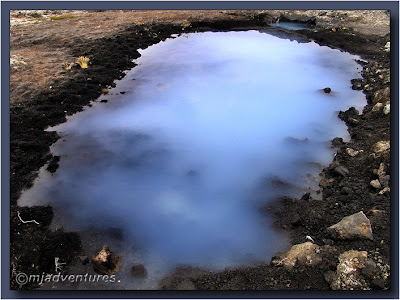
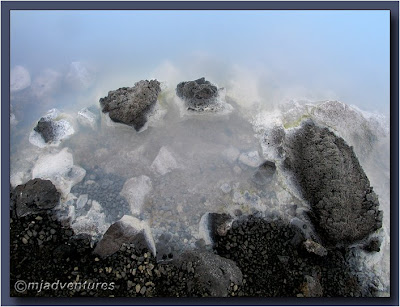
To the left of the main building entry door, a pathway leads off around some pools and meanders over little wooden bridges built across the lagoons. Some nice images can be taken in this area given the right conditions. Unfortunately it was very grey and gloomy for us.
 We spent about 3 hours at the pools on each of our visits, timed to coincide with the bus departures. I certainly wouldn't hire a car to go to the Blue Lagoon only to have it sit in the carpark doing nothing when it's cost an arm and a leg to hire it. The buses do a great job of transporting visitors and it's a hassle-free way to travel.
As I mentioned at the beginning of this post, kids under 12 are free of charge when doing some things in the city. This included riding the buses to and from the Blue Lagoon, and also entry into the pools.
However, it still cost us approx. €80 for 2 adults to ride the bus and get into the pool - and hire 4 towels. Spread out over a family of 4, it averaged at €20 per head which then didn't sound as bad. At least, that what we tried to convince ourselves into thinking!
Next post: Hiring a car, or how to psyche out the car hire customers.
 If you do consider going to Iceland, you have to be prepared for one sure thing: you're going to spend a lot of money. Whatever reasonable daily amount you think you're going to spend, you had better triple it to be on the safe side. While there, we saw some very subdued Americans on vacation who were almost stunned into silence by their poor conversion rates and the cost of everything.The WikiTravel entry on Reykjavik is a great preparatory read and I cannot emphasise enough to heed the warnings on the costs of going there, but you will have an amazing time and see a very beautiful part of the world.I guess that one point to consider is that Iceland only has a window of 4-5 months in which to capture the tourist bucks, so they take every opportunity that they can to part tourists with their money. They do it well!With the exception of petrol (go figure), everything is more expensive in Iceland than in Europe. When we travelled there, the Icelandic Króna (plural is Krónur) was roughly 125 ISK to 1 Euro. It makes for some challenging currency conversion exercises, but we made it a bit easier for ourselves by making the equation simpler: 1,000ISK = 10€ which slightly favoured the ISK, but still gave us ballpark cost figures.We took J's kids (8 and 11) with us, and while it was a great experience and we had a wonderful time, Iceland would be better travelled without children in tow. We could have spent a lot more time in the car and on buses going further afield, (as well as stayed in cheaper accommodation), but the kids are not the most patient travellers in wheeled vehicles. In the air, they're fine: I guess that they know that they can't get out of a plane when it's 36,000' high!
Finding suitable accommodation for 2 adults + 2 kids is not only logistically nightmarish, but hellishly expensive now that hotels have cottoned onto stipulating that only 1 child may share a room with 2 adults. This meant that if we wanted to stay in hotels, we needed 2 rooms and at approx. 120-150€ per night, per room, in an average hotel, we were into some big bucks for just the accommodation.
Luckily, after a lot of time on the internet searching for accommodation in Reykjavik, we came upon Kalli's Apartments which are owned by the lovely Systa, and where we paid the same as we would have done for just one hotel room. Plus we had a kitchen in the apartment and the use of a washing machine and a dryer in the building's basement, and FREE wireless internet access - the latter being most important, for those who know J!
We flew from Berlin's Schönefeld Airport (soon to become Berlin's major International Airport) with Iceland Air and it took me back to a time when onboard travel was pleasurable. Apart from the increased airport security insanity which is an inevitable travel factor nowadays, the crews on the Iceland Air flights were friendly, smiling and very efficient. They handled their tasks and all requests with grace and were keen to provide professional service. Even the announcements by the flight deck crew were audible and entertaining! Some of the "better" airlines could sit up and take notice of Iceland Air's crew training methods and their evident selection of the right people for the job. The planes are currently being kitted out with personal in-seat entertainment systems which we had on the return flight but not on the way there. The seats were reasonably comfortable and slightly wider than most Economy seats on other airlines.
During the meal service on the flight to Iceland, we were introduced to Skyr (pronounced skeer) which is a low-fat dairy product similar to yoghurt but much smoother. We loved the taste and it quickly became a favourite breakfast and snack item.
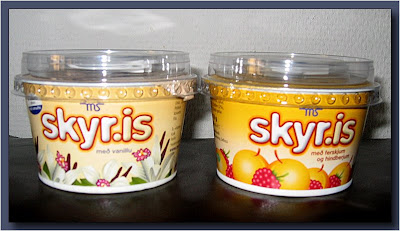
All international flights land at Keflavik International Airport which prides itself on being open 24 hours and 365 days per year. Whether this means planes can land in blizzards, I don't know!
After gathering our luggage, we meandered out expecting to pass through Immigration, but there are no Immigration counters (at least not for flights from Europe) which meant no Iceland stamp in my passport - grrrr!
Keflavik Airport is about 50kms from Reykjavik and if you haven't sold your first-born to rent a car at the airport, then travelling by bus is the easiest and cheaper option between the two points. The bus arrives at the main Tourist Bus Depot in Reykjavik, and from there it's either a shuttle bus to the major hotels or taxi to any other accommodation.
We got a taxi. Most Icelanders speak great English which is a blessing. Most foreigners however, (with perhaps the exception of other Nordic nationalities), will NEVER be able to pronounce Icelandic words with the right intonation and emphasis to be accepted by the locals. J is pretty good because of her German abilities, but the taxi drivers still couldn't/wouldn't understand her. If you're not heading to a well-known landmark, it pays to have your destination address written down to show the drivers!
5 minutes later, we were being greeted by Systa and led into the apartment which was to be our home for the next 4 days. Systa gave us some good advice on where to shop for food and which supermarkets were the cheaper options. In Iceland, Bónus is the equivalent of Germany's Aldi chain and certainly is the best choice when it comes to buying the basic necessities. Our nearest one was only 10 minutes away down the main street.
We experienced some issues when withdrawing cash at the ATM machines. J kept getting the "insufficient funds" message when we knew damn well there was more than enough in the accounts. Of course with every attempt to withdraw, the money amounts were getting blocked by the bank, (to be released a few days later), but it was still a stressful time. Luckily between our various cash and credit cards, we managed to withdraw enough for groceries and to pay Systa for the 4 nights' accommodation. After that, we transferred money from our cash accounts onto our credit cards and most purchases were then charged to our credit card accounts.
Next Post: Reykjavik continued, and the Blue Lagoon
Today we saw this billboard on a Reykjavik street: It's promoting the Reykjavik Art Museum and it sure got our attention!
Seen in Reykjavik: Searches reveal an Icelandic website for the pizzeria, but none for any of the other cities. Perhaps this window maps their ambitions for worldwide pizza domination!
Tonight, we had a Margarita from Devito's and it was really good. We couldn't get anything else as we were also catering to the tastebuds of 2 kids who will eat caviar and oysters yet remain unadventurous when it comes to pizza toppings.
#!@&*!!!
Another great day today. We saw geysers, glaciers, waterfalls, tectonic plates and continental drifts, the site of one of the world's oldest parliaments and the clearest water that I have ever seen. More later when I've had the chance to process the images.
 Well, we're not doing what the t-shirt says, but who knows what will happen next week when we're in wild North-west Iceland, camping with J's friends!
Someone who did eat puffin recently is getting a lot of flak for it!
We have free internet in our Reykjavik rental apartment and it's blazingly fast. I can thoroughly recommend Systa's Apartments as a great place to stay in Reykjavik. Systa is an artist who works in glass and a few of her works are in the building. She's a delightful woman who has visited New Zealand and walked the Heaphy Track. Her name for New Zealand is "Paradise"!
Anyway, Systa has 3 apartments available and believe me, they're great value in a city where accommodation is on the high side, price-wise. Within 5 minutes' walk to the main street shops, restaurants and supermarkets, we're thrilled that we managed to find this great place to stay.
Check out her accommodation website here and her art website here.
First impressions of Iceland:
~ it's a great place - especially when the sun is shining!
~ it's expensive when compared to Europe prices but worth it to see the beauty
~ most Icelanders speak English so it's fantastically easy to ask for anything - for that I thank them!~ the midnight sun is a novelty - it never gets completely dark at this time of year
~ we'll have to come back here to tour the whole island - without the kids!
~ would love to see it in winter - especially for photographic purposes.
Today we've been to the Blue Lagoon. Tomorrow we hire a car and go see what we can see out of Reykjavik. On Monday we fly up to a place called Ísafjörður to begin our camping trip.
Will try to update again before we disappear into the wilds.


