Showing posts with label Fujairah. Show all posts

4 September 2006

Through Wadi Bih

Update:  I notice that a lot of people come to this post after googling to find out if there is a passport control between Dibba and Ras Al Kaimah.  At the time of writing in 2006, there was a control at the RAK end, but since then I have heard reports that this route has been closed to through traffic, and only UAE (maybe GCC) nationals are allowed to use it.  

I'm not sure how you would check that information, but entering it from the Dibba end and expecting to turn back would be the best bet, if you did want to go ahead and try it.  At least you'd get to see the most stunning bits through the wadi and on the high mountain route - and carry your passports just in case they let you back in through RAK!

Don't attempt driving through Wadi Bih if it's been raining or looks as if it's going to rain.  Flash floods rip through the wadi, taking everything away.

Also read:  
Rocky Hajjar Picture Show
The Long and Winding Road


************
The last time that we tried to drive through Wadi Bih, the road had been washed away in the heavy February rains as we wrote here.

We tried again on Saturday, and yippee – it’s open again! The effort by the roadwork gangs to cut another road is admirable, as the boulders they had to move to level out the ground again were HUGE.

The new road running to the left of the Wadi


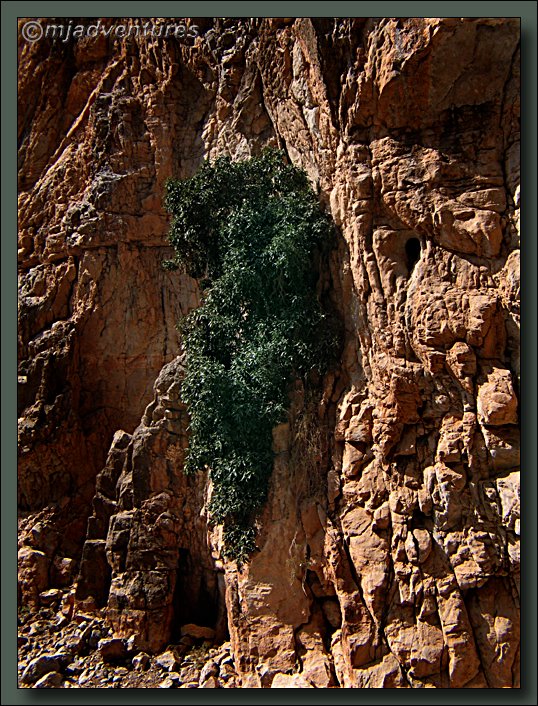
It’s a different scene from last November when we drove through this area for the first time. With all the rock and water damage, the cliff faces have changed shape along with the road. The low-lying plants have all gone too.

Have we told you how much we love our Honda MR-V?!
 

However, it’s still one of our favourite roads and a nice easy 6 hour round trip from Dubai – depending on how many stops are made. As well as getting out of the car in various places in the wadi, one of our best stops is on the top of the mountain ridge which separates Wadi Bih from the Omani Border Post.
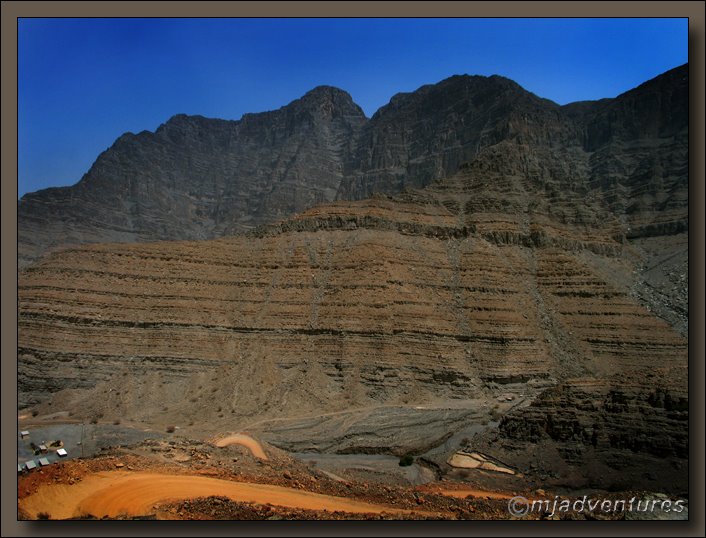


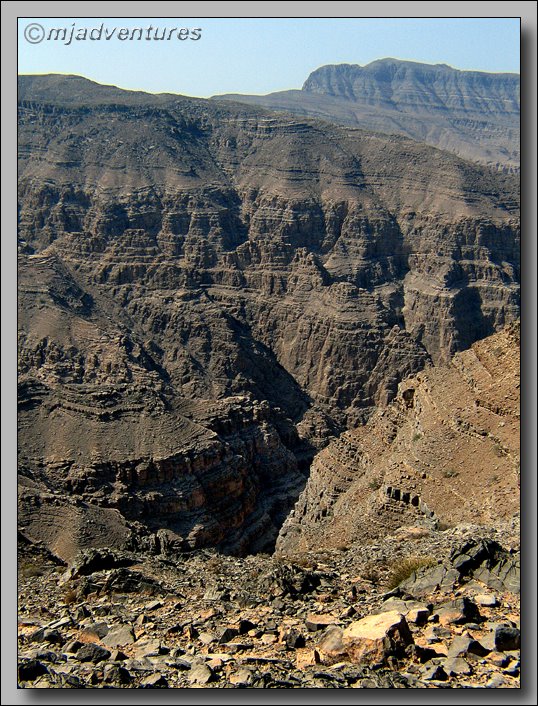
From here, we can see down the Rawdah Bowl over and up to Jabal Harim, picturing that on the other side is another extremely picturesque route that leads to Khasab. The quietness of the surroundings is a joy, as we stand and look at the impressive scenery.
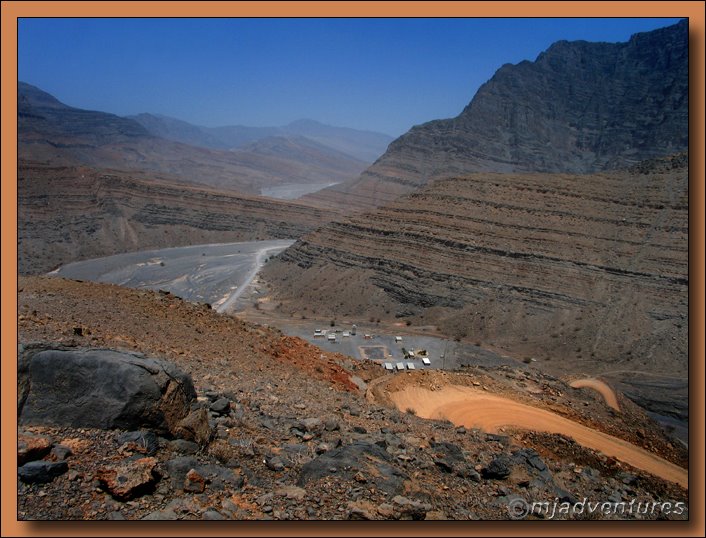
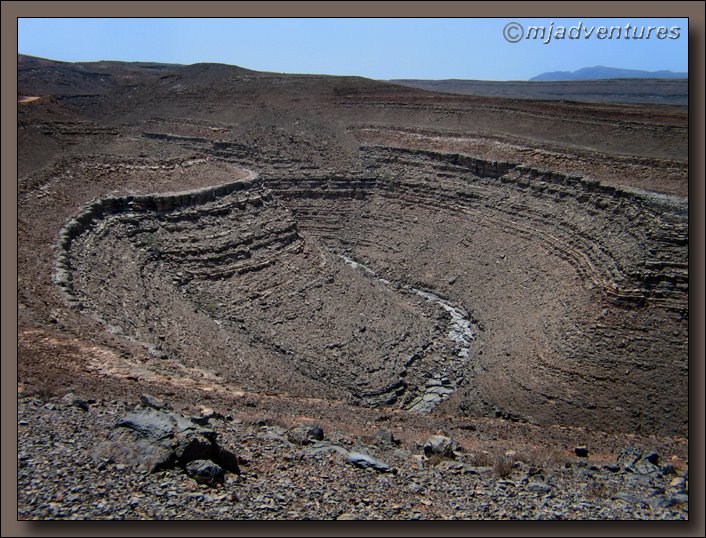
The road leads down to the Omani Border Post, the buildings in the lower middle of the image. The road behind the Border Post leads to the Rawdah Bowl and ultimately to Khasab over Jabal Harim, the tallest peak in the Musandam, and which towers in the far distance.


Outings like this are when we most of all acknowledge how fortunate we have been to live in the UAE.


30 April 2006

Calling all Angels

My dentist’s surgery in Dubai is my second home; I spend a lot of time there, or at least that’s how it feels to me!

On the plus side, it gives me the opportunity to read new publications that I haven’t seen before, and on the last visit, I found a little gem – the UAE Digest.

Although most of the articles are written with an essence of Hindlish and verbosity that my English teacher was so fond of accusing me of, there’s a wide range of interesting topics covered, mostly with reference to the UAE and the surrounding Middle Eastern countries.

In the April issue, there was even a 3 page spread on blogging in the UAE, featuring Gautam representing the Dubai Bloggers’ Group.

UAE Digest's publishing house, Sterling Publications has a website which promotes their other magazine, UAE Banking. I can’t see any links to the UAE Digest, so unfortunately I can’t link to a story written by Bindu Ganesh titled “Fujairah Angel”. However, while Googling for more info, it appears that it’s been covered by many publications, all of which appeared to have received the same Press Release and regurgitated it in some form!

Have you ever been to Fujairah and stared out to sea and seen the horizon dotted with dozens of ships? I thought that they were anchored there to wait their turn to enter the Arabian Gulf through the Strait of Hormuz. Wrong!

It turns out that off the East Coast, there is the world’s second largest ships’ bunker anchorage – a place where ships anchor and stay until they are called into service again. At any time, there may be between 100 to 150 ships out there – all with crews who can’t come ashore because their companies can’t afford/be bothered to ferry them the 15+ miles into the nearest port. I would imagine that there is also the concern that most sailors, once stepping foot on land, would desert their ships - never to be seen again.

Upwards of 2,000 sailors may be out there; unable to communicate with their families back home for weeks on end. Boredom and loneliness are only part of their frustration, and depression wouldn’t be far away for some of these men.

Enter the Mission to Seafarers in Dubai. As part of the international charitable organisation chartered to help all seafarers regardless of colour, race, or religion, the Dubai chapter recently launched its “The Angel Appeal” mission to help the sailors off Fujairah.

Their goal is to raise over US$1 million dollars before 2006 ends, to fund the building and equipping of a boat that will support some of the 140.000+ sailors using the anchorages off the east coast of the UAE each year.

Called the “Fujairah Angel”, the boat will be built by Albawardy Marine in Al Jadaf, Dubai. On board will be an internet café, a book and DVD library, a medical clinic and access to telecommunications so that ET can phone home. A welfare officer will also be onboard to offer pastoral and spiritual support to sailors in need.

The Fujairah Angel is anticipated to be ready to launch at the end of 2006 and will operate every week for 72 hours at a time – sailing between the anchored boats so that sailors can step aboard and spend some time relaxing and in communication with their families and friends back home.

The Fujairah Port Clinic which provides 24 hour medical aid to sailors has already pledged their support to the Angel Appeal, and will man the onboard clinic with paramedics.

As well, some major businesses such as Fujairah National Group, Lamnalco of Sharjah, National Bank of Dubai and Fairmont Dubai have chipped in to help.

If you would like to donate to The Angel Appeal, you can find out how by phoning (+971) 4 3441823.

24 March 2006

Rocky Hajjar Picture Show

Update:  I notice that a lot of people come to this post after googling to find out if there is a passport control between Dibba and Ras Al Kaimah.  At the time of writing in 2006, there was a control at the RAK end, but since then I have heard reports that this route has been closed to through traffic, and only UAE (maybe GCC) nationals are allowed to use it.  

I'm not sure how you would check that information, but entering it from the Dibba end and expecting to turn back would be the best bet, if you did want to go ahead and try it.  At least you'd get to see the most stunning bits through the wadi and on the high mountain route - and carry your passports just in case they let you back in through RAK!

Don't attempt driving through Wadi Bih if it's been raining or looks as if it's going to rain.  Flash floods rip through the wadi, taking everything away.

Also read:    
Through Wadi Bih
The Long and Winding Road


With J’s sister and bro-in-law in town, we decided to take them to Fujairah and then along our favourite road to RAK from Dibba, through the wadi and over the Hajjar range.

About 5km into our gravel journey from Dibba, we had to stop – there was no road!

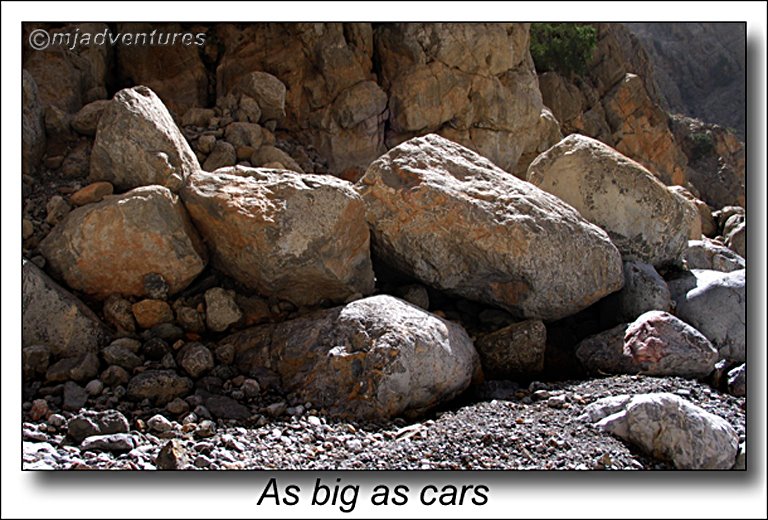
The recent rains have caused considerable damage in this area, and as the road followed a wadi bed through the canyon, the water has washed away the route. In its place is tonnes of rock, gravel and silt. We walked up the wadi over rocks as big as cars, and marvelled at what must have been a most incredible act of nature. The scratches and gouges in the canyon walls from the debris rose 3m above us – that’s how high the water must have been.

We estimate this damaged area to be about 1km long, and without knowing the condition of the rest of the track, it’s going to take a few months to carve a road back out of the debris.

We’ll let the images tell the story - you can click on them to enlarge.
 
Before: 
After:


20 February 2006

The long and winding road..

…that leads from Dibba to Ras Al Kaimah.

Update:  I notice that a lot of people come to this post after googling to find out if there is a passport control between Dibba and Ras Al Kaimah.  At the time of writing in 2006, there was a control at the RAK end, but since then I have heard reports that this route has been closed to through traffic, and only UAE (maybe GCC) nationals are allowed to use it.  

I'm not sure how you would check that information, but entering it from the Dibba end and expecting to turn back would be the best bet, if you did want to go ahead and try it.  At least you'd get to see the most stunning bits through the wadi and on the high mountain route - and carry your passports just in case they let you back in through RAK!

Don't attempt driving through Wadi Bih if it's been raining or looks as if it's going to rain.  Flash floods rip through the wadi, taking everything away.

Also read:  
Rocky Hajjar Picture Show
Through Wadi Bih

  
Click on the images to enlarge

A couple of weekends ago, we again spent the weekend in Khasab showing J's parents the beauty of the place - including the dhow trip and the Hajjar mountains as on the previous trip posted here.

It reminded me that I still hadn't written about doing the journey from Dibba to Ras Al Kai
mah as I promised a few weeks ago, when we went diving in the Musandam - so here goes.We decided to travel back the long way – going from Dibba into Oman, travelling over the Hajjar Mountains and onto Ras Al Kaimah.

Although the road officially goes into Oman, no visas are required. However, you do need to show your passports at the RAK end of the road, so we were really pleased that we had thought to pack them!

We had previously travelled on some of this road on an earlier trip into Northern Oman and Khasab, and it had been spectacular. On that journey, we were turned back at the small Omani border post at the intersection of the 3 roads – 1 from Khasab, 1 from Dibba, and the other from RAK – because there is no passport control at this outpost. So we had been determined to do the road on the other side of the border post – and that’s what this story is all about.


At the round-a-bout where the right-turn is for Dibba port, the left turn leads to Khasab. Shortly after the round-a-bout is another left turn that is signposted for Khasab. The road quickly turns from tarseal to gravel, but in dry conditions it's perfectly navigable in a car.

We drove along flat open ground for a while, before the gap between the mountains started to narrow. It quickly became evident that the road was to follow a wadi path through the mountains that in wet
conditions would probably be a raging torrent – we were happy that it was still dry!

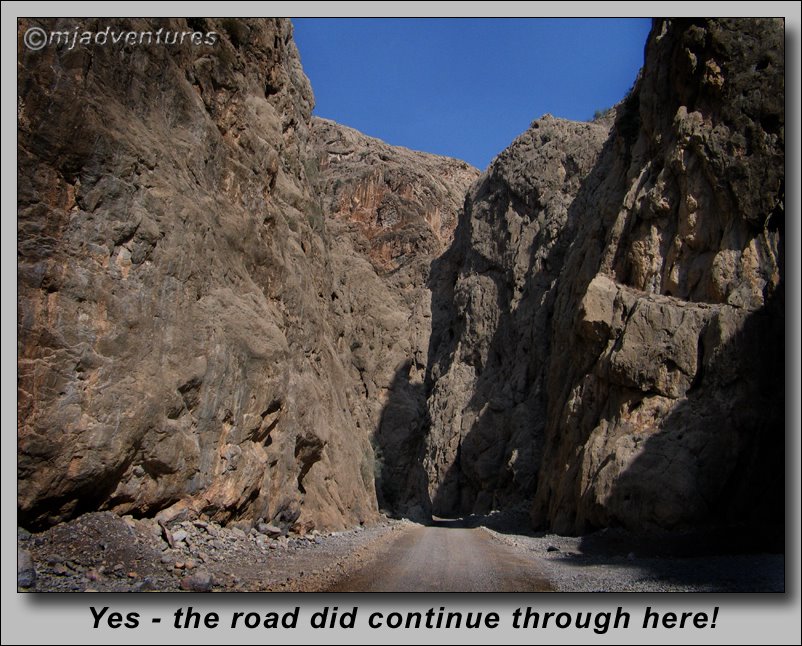
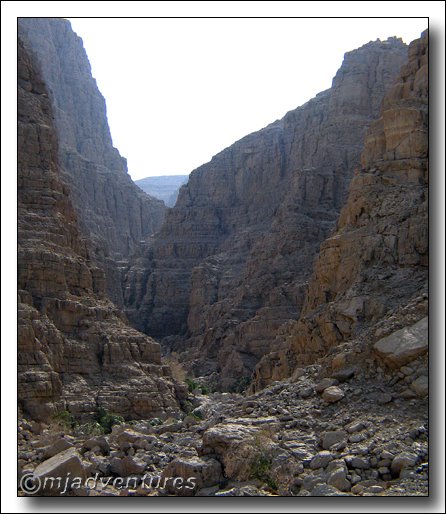
We were astounded by what we encountered – at times it seemed as if the road had disappeared into a sheer cliff face, only to find that a tiny gap opened up between the mountains to allow the narrow road to continue up the wadi. We were smiling with happiness – the beauty of the surrounding nature was at times overwhelming – and there were no words, just feelings.
  
We stopped many times to take photos and to absorb the scenery – it was so quiet. After about an hour, the gap between the mountains started to widen, and we were soon climbing up the steepest part of the road. The strata in the rocks and hills around us were incredible – there must have been some massive earth movements to have created these layers. It was like looking at waves or water currents, but in solid rock.
  
Before descending to the check point, the road travelled along the top of a ridgeline that dropped off a few thousand feet on one side. We got that “Grand Canyon” feeling all over again.At the check point, there is a barrier across the road. J got out and spoke to the guard, who was rather shy because he didn’t speak much English, and was very apologetic about it. However, a smile from J and the magic words: “Ras Al Kaimah” did the trick, and the barrier lifted so that we could turn left onto the road to RAK.

This part of the road was
flat and in the middle of a wide valley. We sped along here before reaching another checkpoint, where we lined up behind 3 other cars. On the other side of the barrier were 6 vehicles coming into where we had just been. The border guard was being extremely diplomatic – he would deal with one vehicle from one side, and then the next vehicle he would service would be from the other side!

It was a bit of a laborious task: the guard collected passports from a vehicle; walked back to his booth; wrote the passport numbers in his book; walked back out to the car to give back the passports; walked to the barrier, opened the barrier to let the vehicle through; closed the barrier; then walked to the next vehicle to repeat the performance!

Luckily we were in no hurry – and M was entertained by a phone call from her photographer friend V in Australia for a few minutes. It was one of those surreal moments – sitting in a vehicle at a checkpoint in the UAE and a long way from Australia; having a conversation with a friend who was driving home in the dark in NSW after shooting an all-day wedding!

We got through the checkpoint where the road was sealed once more and drove through the back suburbs of RAK to the main road. After turning onto the Emirates Road, it was an easy drive ba
ck to Dubai, and another want-to-do journey crossed off our list!
  
This is an easy all day trip if you were to start early in Dubai, cross over to Dibba and then travel the road over the Hajjars to RAK. Better still would be to leave the night before and spend it in a hotel in Fujairah Emirate, before doing the drive over the mountains - as we did.

It’s well worth the effort, and I know that we’ll also be going back there with the various overseas visitors, so that we can show off a beautiful and natural part of this country to them.

5 February 2006

20 November 2005

Diving in the Musandam

A couple of weekends ago, we went to the Emirate of Fujairah on the east coast of the UAE for a spot of diving. As the dhow was due to leave Dibba Harbour on the Omani side at an early hour on Friday, we drove over on Thursday night.

We stayed at the Sandy Beach Hotel which was comfortable and had a good restaurant. The only downer was the amount of disinfectant that they used to clean the rooms - the smell left
us with a headache akin to a mild hangover when we woke in the morning!

Early on Friday we boarded the dhow, and were soon out of the harbour and cruising on a smooth sea - north towards the Strait of Hormuz. After a couple of hours of motoring, and having the luck of a solitary dolphin riding the bow wave, the dhow made its way around the point between Limah Rock and the mainland. We anchored in the shelter of the point with the town of Limah in the distance.

The divers transferred onto the smaller and faster dive boat tender, and we were soon rocketing back towards Limah Rock to do the first dive of the day on the South Wall. Over the side we went, into a cool sea with visibility that wasn't the best, as there was a lot of plankton. It got better as we got deeper, and at around 20m, we were able to see about 15m around us.

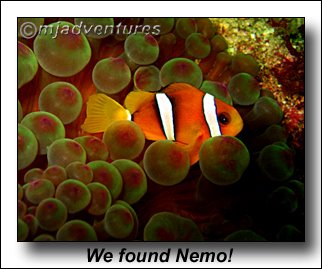
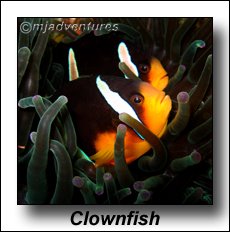
The dive was an interesting one - lots of eels, coral formations and fish of all varieties including some territorial hammour. M was diving for the first time with her new underwater housing for her Canon camera and was keen to try it out. As the visibility was not that great with all the sediment in the water, the images were all closeups. The eels were very obliging and posed beautifully, the clown fish were a bit concerned that their space was being invaded, and the lion fish couldn't have cared less!

After an hour, we surfaced to be picked up by the dive tender and taken back to the dhow, where the crew had laid out the most delicious lunch which was devoured by the hungry divers.

The next dive was in the next southern bay on a site called Wonder Wall. Here, as well as eels and fish, we saw resting stingrays and the most enormous porcupine fish that allowed M to swim beside it and actually stroke it! It was totally unafraid, and swam around M for a while before heading off into the deep.

This dive was spectacular because of the rock formations underwater. It was a great experience to swim around a big rock and be surrounded by big schools of fish.

Another hour passed quickly by and after being picked up by the tender, we sped
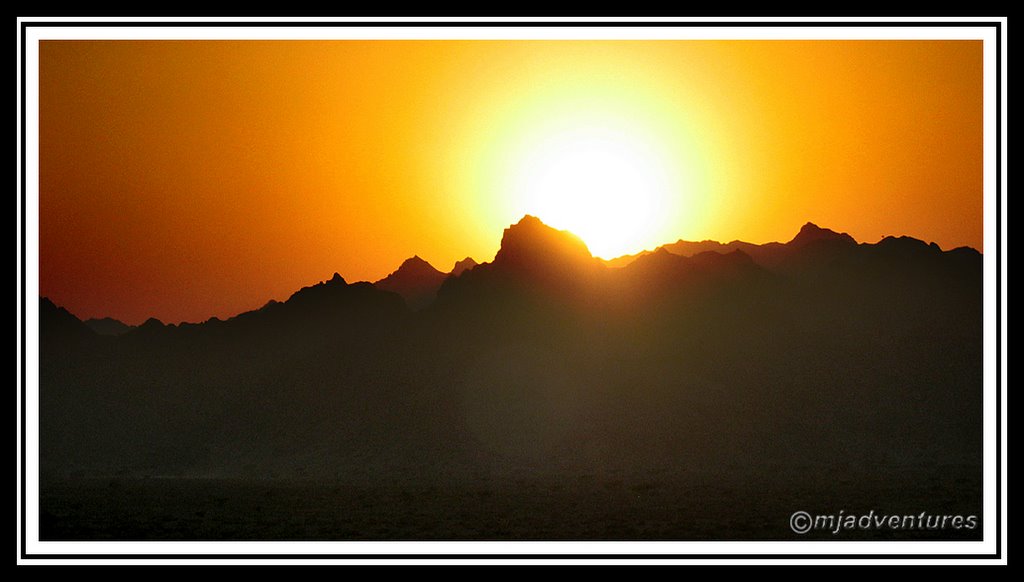
off in pursuit of the dhow that had started back to Dibba. We caught up with it in a quiet and calm bay and transferred over, making way under a rising moon and with dusk quickly falling. It was truly beautiful to watch the light fading over the rugged Hajjar mountain range, and see the twinkling lights of Dibba come ever closer.

It was a great day, and we met some wonderfully nice people onboard - it was great to spend time with interesting folk and learn more about life from their experiences.

We stayed another night at the Sandy Beach Hotel, as the next day we were going to travel
back to Dubai on the gravel road via Oman and Ras Al Kaimah - but that's another story that will be told later!