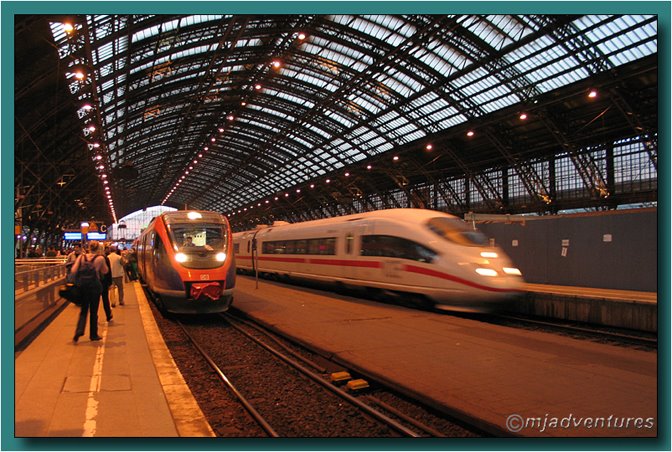
Visiting Photokina a couple of weeks ago also brought the opportunity to go into Cologne (Köln) for a few hours before catching our train back to Berlin.
Before you think that we’ve lost all sense of taste with the border colour of our images, let me explain!
How many of you remember (or know about) 4711 Eau de Cologne? How many of you know that it is actually made in Cologne, and is still manufactured today?
M’s grandmother was an avid fan and user of 4711 Eau de Cologne, and her birthday date was the day after our Cologne visit. I remember standing in her bedroom, holding the 4711 bottle and gazing at the detail of the gold filigree on the label. On the recent visit to J’s parents, we discovered that her grandmother was also a 4711 user.
So, as a tribute to our late maternal grandmothers, we’ve coloured the image borders in this post to reflect the trademark colour of the 4711 label! Displays of the 4711 products could be seen all over the city.
Click on the images to enlarge them in your browser

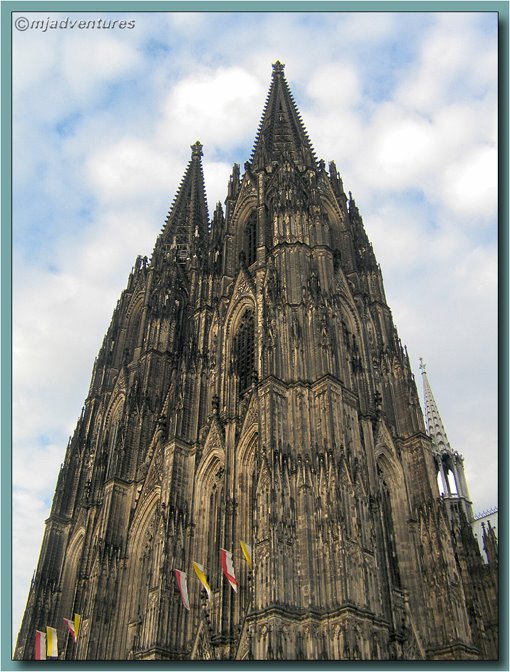
Upon leaving the train station and walking out into the open air, the most imposing sight greets visitors to the city. The Cologne Cathedral (Kölner Dom) dominates the skyline, exuding a mixture of impressions – fear, wonderment, awe, and foreboding. Cologne is built around the cathedral, and it has the largest façade of any cathedral in the world – it is truly mind-boggling to see the detail and intricacy of the thousands of carved figures, and the actual shape of the building, and take into account that all this work was done mostly by sight and by hand – no computers, no laser alignment equipment, no modern day equipment.
This is what greets you when exiting the train station

The foundation stone was laid in 1498. Intended to be the seat of the Archbishop of Cologne, the church is under the administration of the Roman Catholic Church, but run as an independent entity.

If you’ve read Ken Follet’s The Pillars of the Earth, you’ll have some idea of how long these cathedrals take to build. Generations of families work as architects, builders and stonemasons to complete the construction which can span centuries. The Cologne Cathedral is no exception, taking 600 years and the intervention of the Prussian royalty to ensure that it was finally finished in 1880. The 2 taller spires reach to 157m, and the whole structure is 144m long and 86m wide.
Walking around inside reveals what a masterpiece of craftsmanship and architecture this building is. The exceedingly high naves curved over the top of us – largely unhindered by any ugly structural reinforcement – a true work of engineering art.
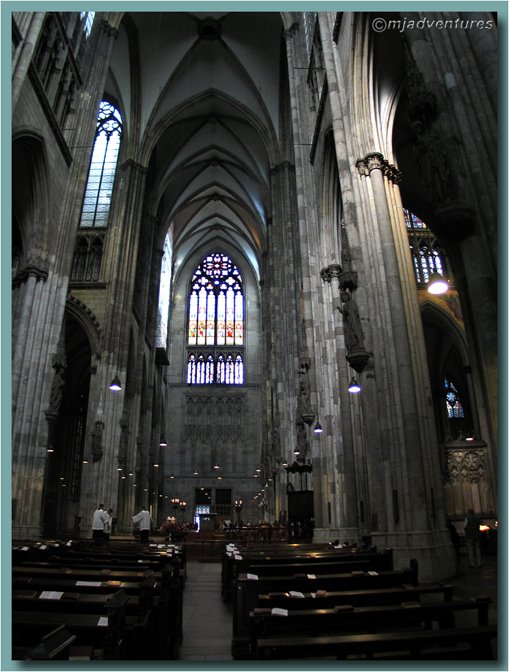
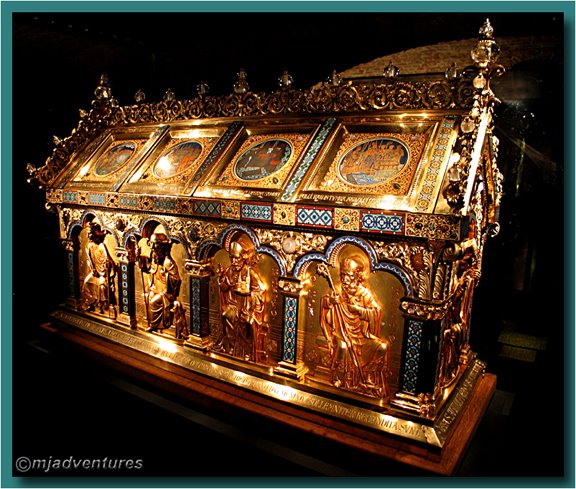
Shrine of the Three Kings
Of course, in the cathedral there are many artworks and religious symbols of great significance to the Roman Catholic faith – and also one which transcends denomination to touch all faiths, for here is the resting place of the 3 Kings – The Shrine of the Magi. Also known as the 3 Wise Men, they are thought to have been of Persian descent, and travelled to Bethlehem following a star, to bring gifts for the newborn Jesus.
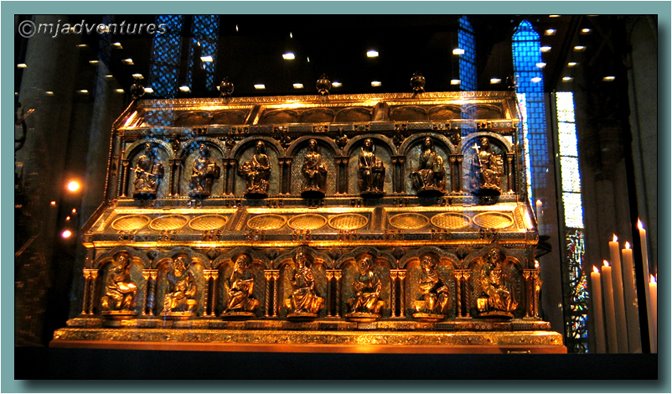 Placed above the high altar in the cathedral, the 13th century Magi reliquary shines with a golden light and is believed to be the largest reliquary in the world. The graves of the Magi were reputed to have been found by St. Helena on a pilgrimmage to Palestine and the Holy Lands. She took them back with her to Constantinople (Istanbul). Later, they were moved to Milan before being brought to Cologne in 1164 by the Holy Roman Emperor, Frederick Barbarossa I.
If you ever get the opportunity to visit the shrine, look at the mosaics on the floor all around the altar. They depict people of different skills. Most interesting is the one directly in front of the altar. In the circle around the main image, are images of women as astronomers, architects, and other careers that would not have been thought to be women's work during the era of the church construction. Unfortunately I couldn't get a photo of it because of the over-zealous minders telling off anyone who wanted to take photos!
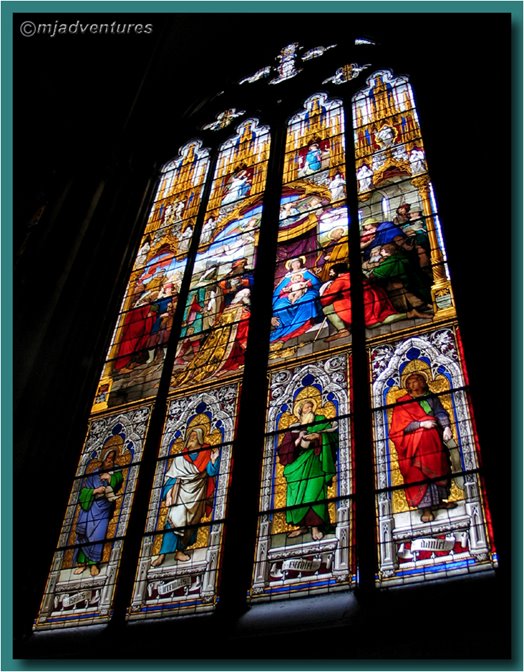
After walking around the interior of the cathedral, and getting cricked necks from all the upwards gazing, we decided to go up to where we had been staring.
The Spire
One of the 157m spires is open to the public to be climbed – 509 steps up to the 95m observation platform. 509 of mostly narrow spiral staircase echoing with the huffing, puffing and groaning of gung-ho climbers like us who decided to brave the ascent!
The right-hand spire is the one we climbed
The Bells, the Bells
Halfway up the spire is the Belfry where we paused for a well-earned rest, sinking gratefully onto a wooden bench to wipe the sweat from our brows and gaze at the 12 enormous bells which hang there. In the center of the Belfry sits the Master of all bells, the bell of St. Peter – the world’s largest free-swinging bell weighing 24 tons.
Any bats in this belfry would surely be deaf!
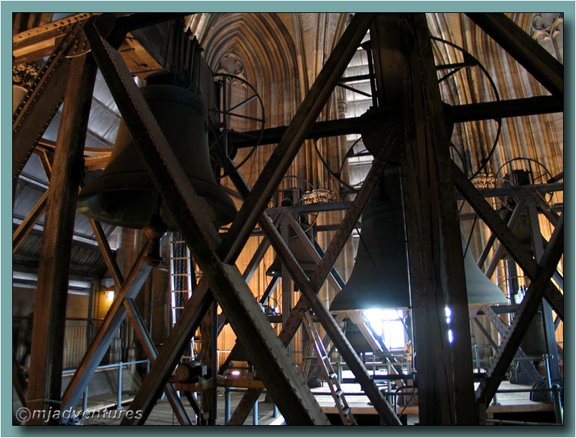
We were lost in the wonderment of trying to figure out how, all those years ago, they made a mould that big, melted enough metal in one go and poured the bell in a single cast. Fantastic. While in the Belfry, we heard the half hour chime on the way up and the hour chime on the way back down. One word – LOUD!
The Spire continued
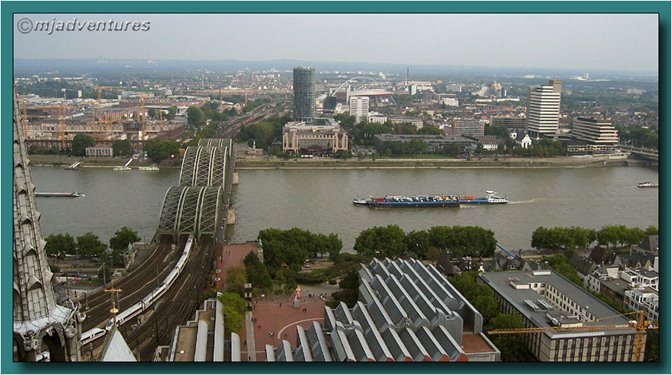
After our break in the Belfry, we continued to ascend the steeple, finally getting to the observation deck to gaze over the city and stand in the cooling breeze. If they had sold bottled water in the Belfry or on the deck, I would have bought the lot!
Looking up

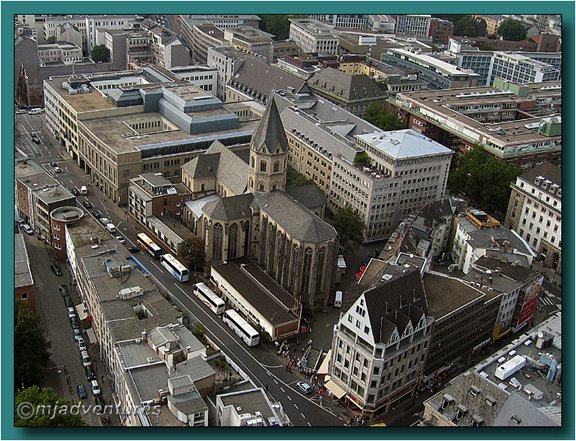
It was wonderful to look over Cologne with the Rhine River running languidly through it, and to look down at all the buildings surrounding the cathedral.
Looking down
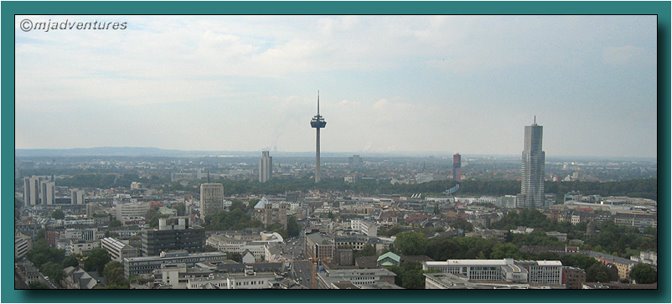
The Treasury
After our descent, we made a pit stop at the nearby café in the square for a glass of cold water and another of cold local beer! The ice cream sundaes looked so tempting, but we were very controlled!
We rested down there!
 Rehydrated, we made our way to the door of the cathedral treasury, where we descended into the depths of the church to hunt for relics. We were fortunate to latch onto a guided tour of some detail. The visiting group was from another German Catholic church, and their priest had brought them to Cologne to see the Cathedral. Of course, the information which was given to them was far more detailed than the standard tour patter!
The first vault room under the cathedral

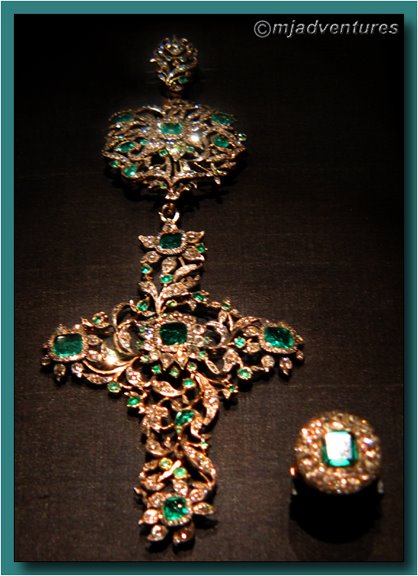
What these vaults contain is truly breath-taking. In the first chamber were reliquaries, chalices, crosses, crucifixes of incredibly intricate and detailed crafting – gold, silver, and precious stones uniting in exquisite harmony.
A ceremonial cross with Limoges inlays

Exquisite reliquaries


The Archbishop wears this brooch and ring for special services
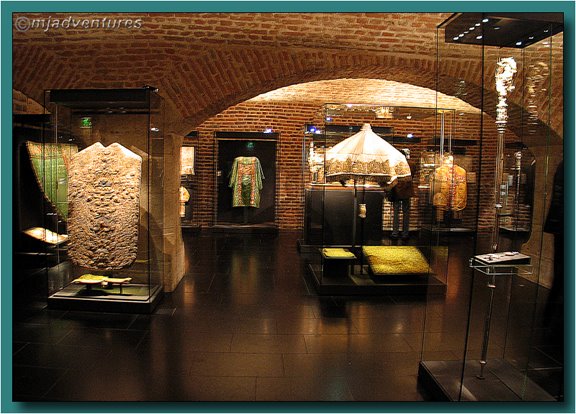
The next chamber held clerical robes of such finery that MamaDuck would quack with delight. Silks, wools, silver and gold thread, precious and semi-precious stones – sewn, woven and embroidered into garments and tapestries of intricacy.
The Tapestry Room
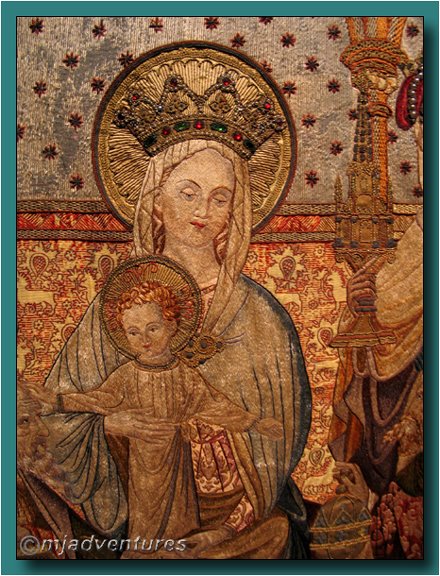
Look at the detail in this tapestry of the Magi visiting baby Jesus – truly wonderful. Semi-precious stones, such as the one in Mary's crown have also been added.

A selection of the clergy vestments on display
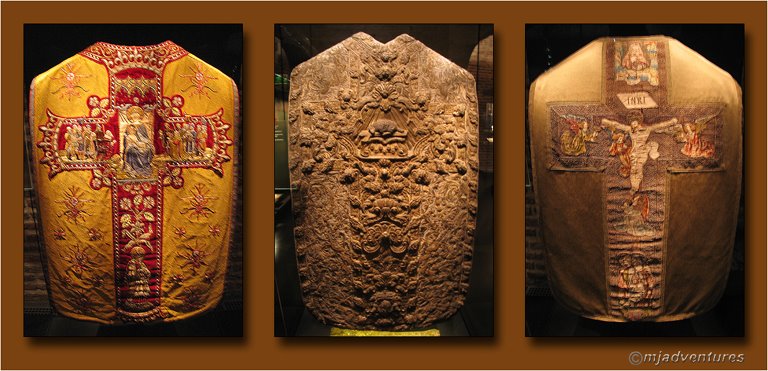
Mitres and Altar cloths

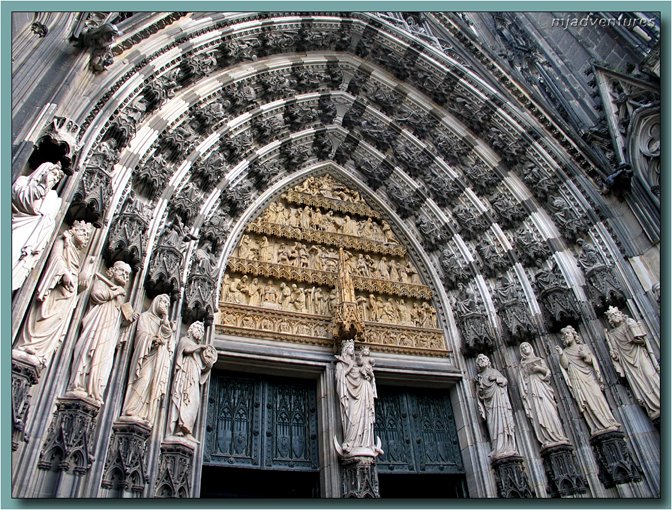
In a neighbouring chamber sat some of the restored statues from the exterior of the cathedral and it was great to be able to get a closer look at the detail and to be able to achieve a sense of scale.
These smaller ones, shown here, number in their hundreds around the cathedral exterior and are mostly found in the apexes above the doors.

In this image they are black and unrestored, in 4 rows lining the arch above the heads of the lifesize statues at the bottom.
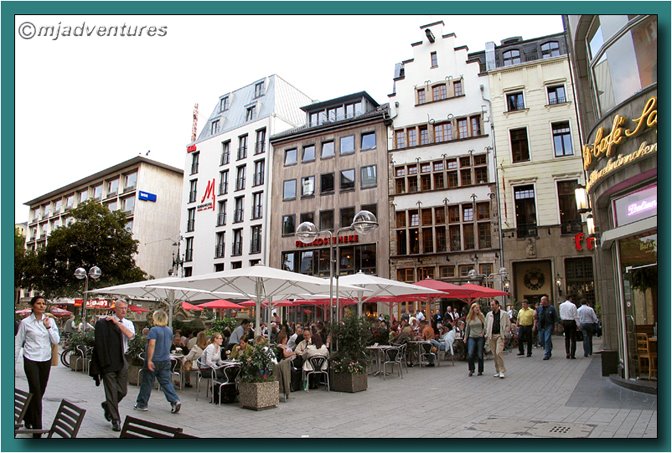
Leaving the Treasury bang on closing time, we had just enough time to walk through some of the surrounding cobblestoned streets and eat a traditional German meal of sausages, potatoes, and red cabbage - washed down with another couple of beers!

Then it was back to the station to catch the ICE train to Berlin.