Closing this year's Festa al Cel was Patrulla Águila (Eagle Patrol) which is the Spanish Air Force's jet precision team.
I was lucky enough to catch their practice run on the Friday before the airshow as well as their official performance, so the weather variations in my images reflect the 2 days.
Flying CASA C-101 Aviojets, the team operates from the San Javier Airbase in Spain's Murcia region. They are the only team in the world to use yellow smoke which is one of the two national colours of Spain; the other being red.
Their display was extremely competent with tight formations and manoeuvres, and they were one of the few displays that flew close enough to the beach to make it more exciting.
This year, the team has a Catalan leader from Barcelona - Comandante José María "Pep" Alonso - and this made it all the more special for the crowd because a local boy was in charge!
The team is also known for its formation take-off and landing displays which quite often aren't thought about in the schematics. For shows based at airfields, this means that Patrulla Águila gives a comprehensive display from the moment that the pilots march onto the airfield to get into their planes until the time that they march out after the display.
This year is the team's 21st year of operation in which time it has grown from a formation of 5 aircraft, then 6, and finally to its present configuration of 7. Over 16,000 flight hours have been logged in this time.
As well as flying as part of a lot of Spain's national celebrations, Patrulla Águila has also flown demonstrations in countries such as Finland, Israel, Portugal and Turkey and, since 2003, there are annual tours to events in America and Canada.
For more posts on the Barcelona Airshow, click on the Label "Festa al Cel" below.
Showing posts with label Festa al Cel. Show all posts
4 November 2010
2 November 2010
Yakovlev 11 and replica Mitsubishi A6M Zero
The coolest thing about Festa al Cel is that it's held in Barcelona which means that there are lots of countries' air forces and air museums within close proximity to call on and invite to participate.
The Belgian, French and the Netherlands air forces were well-represented this year; Fundació Parc Aeronàutic de Catalunya Museum based at Sabadell is almost within spitting distance; EADS is across the French/Spanish border at Perpignan, and Amicale Jean-Baptiste Salis Air Museum (AJBS) is located just south of Paris.
Along with the American P-51D Mustang that I covered in an earlier post, AJBS also flew in a Russian Yakovlev 11 and a replica Japanese Mitsubishi Zero.
In aviation circles, the Yakovlev is referred to the Russian equivalent of the American T-6 Texan Harvard, and their roles are very similar as both were used as airforce training planes.
Widely used by about 18 countries that were influenced by Russian weaponry and armament, the Yak-11 saw duty from 1947 until 1962. In 1950, a North Korean Yak-11 became the first registered "kill" of the Korean War when it was shot down by a US Airforce F-82 Twin Mustang which is an aircraft also worth researching.
After the Yak-11 was retired from active service, it became a much sought-after machine. Pilots bought and modified them into high performing aircraft for air races, and warbird enthusiasts purchased them for museum and private collections. Of the 3,859 built, approximately 120 Yak-11s are still capable of flying today, and most of these reside in Eastern Europe.
There are less than 10 known intact and airworthy Japanese Mitsubishi A6M Zero aircraft left in the world which is a tragedy given the aircraft's history. Most of these have been modified in some way, using pieces from other aircraft or especially manufactured parts, as well as replacement engines. Only one aircraft is known to still have the original radial 14-cylinder, 1,200hp Nakajima Sakae 31 engine.
The example from AJBS is not a genuine Zero as it started life as a single-seater American T-6 Texan Harvard. These were built for movie purposes, and starred in famous movies such as Tora! Tora! Tora! and Pearl Harbor.
Just over 10,000 units were manufactured in a brief period from 1940-1945 which was when Japan used them for WWII and the Pacific War. They were excellent long-range machines for use off aircraft carriers, and are perhaps best known for their part in the deadly and effective raid on Pearl Harbor, Hawaii, in the early morning hours of December 7th 1941. The Zero's fearsome reputation was sealed when it became the machine for the loyal kamikaze pilots. The success of the missions depended on the pilots committing suicide as they would steer their aircraft, ( heavily laden with explosives and fuel), into direct impacts with enemy ships - especially aircraft carriers.
Although more Zeros were built than any other Japanese aircraft over WWII, its effectiveness was short-lived as opposing forces quickly developed their own aircraft (P-38 Lightning, Corsair F4U and F6F Hellcat among them) and strategies, to counter-attack the onslaught of the Japanese Air Force.
For more posts on the Barcelona Airshow, click on the Label "Festa al Cel" below.
The Belgian, French and the Netherlands air forces were well-represented this year; Fundació Parc Aeronàutic de Catalunya Museum based at Sabadell is almost within spitting distance; EADS is across the French/Spanish border at Perpignan, and Amicale Jean-Baptiste Salis Air Museum (AJBS) is located just south of Paris.
Along with the American P-51D Mustang that I covered in an earlier post, AJBS also flew in a Russian Yakovlev 11 and a replica Japanese Mitsubishi Zero.
In aviation circles, the Yakovlev is referred to the Russian equivalent of the American T-6 Texan Harvard, and their roles are very similar as both were used as airforce training planes.
Widely used by about 18 countries that were influenced by Russian weaponry and armament, the Yak-11 saw duty from 1947 until 1962. In 1950, a North Korean Yak-11 became the first registered "kill" of the Korean War when it was shot down by a US Airforce F-82 Twin Mustang which is an aircraft also worth researching.
After the Yak-11 was retired from active service, it became a much sought-after machine. Pilots bought and modified them into high performing aircraft for air races, and warbird enthusiasts purchased them for museum and private collections. Of the 3,859 built, approximately 120 Yak-11s are still capable of flying today, and most of these reside in Eastern Europe.
There are less than 10 known intact and airworthy Japanese Mitsubishi A6M Zero aircraft left in the world which is a tragedy given the aircraft's history. Most of these have been modified in some way, using pieces from other aircraft or especially manufactured parts, as well as replacement engines. Only one aircraft is known to still have the original radial 14-cylinder, 1,200hp Nakajima Sakae 31 engine.
The example from AJBS is not a genuine Zero as it started life as a single-seater American T-6 Texan Harvard. These were built for movie purposes, and starred in famous movies such as Tora! Tora! Tora! and Pearl Harbor.
Just over 10,000 units were manufactured in a brief period from 1940-1945 which was when Japan used them for WWII and the Pacific War. They were excellent long-range machines for use off aircraft carriers, and are perhaps best known for their part in the deadly and effective raid on Pearl Harbor, Hawaii, in the early morning hours of December 7th 1941. The Zero's fearsome reputation was sealed when it became the machine for the loyal kamikaze pilots. The success of the missions depended on the pilots committing suicide as they would steer their aircraft, ( heavily laden with explosives and fuel), into direct impacts with enemy ships - especially aircraft carriers.
Although more Zeros were built than any other Japanese aircraft over WWII, its effectiveness was short-lived as opposing forces quickly developed their own aircraft (P-38 Lightning, Corsair F4U and F6F Hellcat among them) and strategies, to counter-attack the onslaught of the Japanese Air Force.
For more posts on the Barcelona Airshow, click on the Label "Festa al Cel" below.
31 October 2010
F/A-18 Hornet
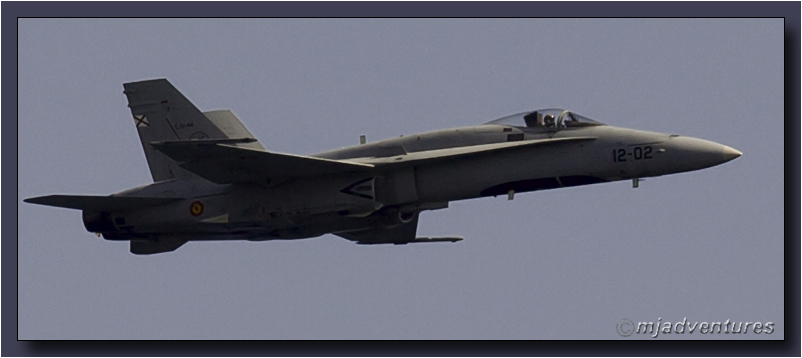
2 F-16s (one each from the Netherlands and Belgium) had put on stunning displays of manoeverability and missile avoidance, and now it was the turn of the F-18 from the Aérea de Torrejón Base in Spain which is the Ala 12 squadron's home.
The F-18 is an extremely versatile military aircraft, used in providing air defence for navy fleets, fighter escort for transport and bomber planes, air-to-ground and air-to-air combat, and reconnaissance.
In comparison to the single engine F-16, the twin engine F-18 is quieter, in that its engine noise isn't as harsh and doesn't rip up the air.
Where it shines is that it's highly manoeverable owing to its powerful thrust to weight ratio, and the pilot demonstrated this ability very well, by tail-walking the F-18 at low altitude along the beach, and then applying thrust to take the plane into a steep ascent at low speed. It was awesome to watch.
To read more posts on the Barcelona Airshow, click on the Label "Festa al Cel" below.
The F-18 is an extremely versatile military aircraft, used in providing air defence for navy fleets, fighter escort for transport and bomber planes, air-to-ground and air-to-air combat, and reconnaissance.
In comparison to the single engine F-16, the twin engine F-18 is quieter, in that its engine noise isn't as harsh and doesn't rip up the air.
Where it shines is that it's highly manoeverable owing to its powerful thrust to weight ratio, and the pilot demonstrated this ability very well, by tail-walking the F-18 at low altitude along the beach, and then applying thrust to take the plane into a steep ascent at low speed. It was awesome to watch.
To read more posts on the Barcelona Airshow, click on the Label "Festa al Cel" below.
Labels:
Barcelona,
Catalonia,
Catalunya,
Festa al Cel,
Spain,
Spanish Air Force
30 October 2010
Antonov 2R
As far as Russian planes go, there are 3 manufacturers whose names stand above the rest - Antonov, Tupolev and Yakovlev.
The 1st and 3rd had representation at Festa al Cel this year, and Antonov's 2R biplane was the better known.
This remarkable aircraft is a derivative of the original An-2 which was manufactured in its model variants from 1946 until 1991. It stood in the Guinness Book of World Records for the longest production run of any aircraft, but was only recently overtaken by the Lockheed C-130 Hercules.

The An-2 had many guises, but was better known as a crop-duster for which it was initially built. It has also been used as a people and cargo carrier, firefighter and a parachute drop aircraft.
The Fundació Parc Aeronàutic de Catalunya plane on display at Festa al Cel was a 2R which is a crop-dusting derivative of the An-2, and originally fitted with a large tank to hold the chemicals.
An interesting feature of the Antonov was that it had no stall speed - the speed at which aircraft stop flying and fall back to Earth.
The pilot's handbook said, "If the engine quits in instrument conditions (blind flying when you can't see the ground) or at night, the pilot should pull the control column full aft (it won't stall) and keep the wings level. The leading-edge slats will snap out at about 64 km/h (40 mph), and when the airplane slows to a forward speed of about 40 km/h (25 mph), the airplane will sink at about a parachute descent rate until the aircraft hits the ground."
Pilots also report that the aircraft is fully in control at 30mph - incredible! A modern-day Cessna has a stall-speed of about 50mph.
For more posts on the Barcelona Airshow, click on the Label "Festa al Cel" below.
The 1st and 3rd had representation at Festa al Cel this year, and Antonov's 2R biplane was the better known.
This remarkable aircraft is a derivative of the original An-2 which was manufactured in its model variants from 1946 until 1991. It stood in the Guinness Book of World Records for the longest production run of any aircraft, but was only recently overtaken by the Lockheed C-130 Hercules.

The An-2 had many guises, but was better known as a crop-duster for which it was initially built. It has also been used as a people and cargo carrier, firefighter and a parachute drop aircraft.
The Fundació Parc Aeronàutic de Catalunya plane on display at Festa al Cel was a 2R which is a crop-dusting derivative of the An-2, and originally fitted with a large tank to hold the chemicals.
An interesting feature of the Antonov was that it had no stall speed - the speed at which aircraft stop flying and fall back to Earth.
The pilot's handbook said, "If the engine quits in instrument conditions (blind flying when you can't see the ground) or at night, the pilot should pull the control column full aft (it won't stall) and keep the wings level. The leading-edge slats will snap out at about 64 km/h (40 mph), and when the airplane slows to a forward speed of about 40 km/h (25 mph), the airplane will sink at about a parachute descent rate until the aircraft hits the ground."
Pilots also report that the aircraft is fully in control at 30mph - incredible! A modern-day Cessna has a stall-speed of about 50mph.
For more posts on the Barcelona Airshow, click on the Label "Festa al Cel" below.
29 October 2010
Catalina over Catalonia
The plane that captured my heart at this year's show - the Consolidated PBY-5A Catalina!
My fascination with "flying boats" or "amphibious aircraft" began at a young age, when my father would drive my family down to Laucala Bay in Suva, Fiji to watch the New Zealand Air Force Sunderlands take off and land. These were the quietest moments for my parents, as my brother and I would sit spellbound, watching these huge craft either disengage out of a watery clasp, or climb ashore after landing, seawater streaming off every curve.
The PBY-5A Catalina is a wondrous beauty of classic aviation. I would run onto my verandah in Auckland to watch the local Catalina fly by. The engine noise is distinctive, and she's up there on my list of "must-view-at-every-opportunity" aircraft, along with the DC-3 and Harvard.
The plane on show at Festa al Cel is owned by The Catalina Society based at Duxford Airfield in the UK. The full history of this aircraft records her beginnings with the Canadian Airforce, before various stints as a transporter and a firefighting water-bomber.
She was then converted to a passenger carrier for a sight-seeing venture in Zimbabwe but that fell through, and after some time in storage in Nanaimo, The Catalina Society purchased and flew her from British Columbia, in Canada, to the UK. She is now used in airshows and sightseeing flights.
More posts on the Barcelona Airshow can be viewed by clicking the Label "Festa al Cel" below.
My fascination with "flying boats" or "amphibious aircraft" began at a young age, when my father would drive my family down to Laucala Bay in Suva, Fiji to watch the New Zealand Air Force Sunderlands take off and land. These were the quietest moments for my parents, as my brother and I would sit spellbound, watching these huge craft either disengage out of a watery clasp, or climb ashore after landing, seawater streaming off every curve.
The PBY-5A Catalina is a wondrous beauty of classic aviation. I would run onto my verandah in Auckland to watch the local Catalina fly by. The engine noise is distinctive, and she's up there on my list of "must-view-at-every-opportunity" aircraft, along with the DC-3 and Harvard.
The plane on show at Festa al Cel is owned by The Catalina Society based at Duxford Airfield in the UK. The full history of this aircraft records her beginnings with the Canadian Airforce, before various stints as a transporter and a firefighting water-bomber.
Retractable floats are lowered for water landings. When retracted, the floats become the wingtips.
She was then converted to a passenger carrier for a sight-seeing venture in Zimbabwe but that fell through, and after some time in storage in Nanaimo, The Catalina Society purchased and flew her from British Columbia, in Canada, to the UK. She is now used in airshows and sightseeing flights.
More posts on the Barcelona Airshow can be viewed by clicking the Label "Festa al Cel" below.
Labels:
Barcelona,
Catalonia,
Catalunya,
Festa al Cel,
Spain
27 October 2010
Helicopter Displays
Festa al Cel wasn't short of helicopter displays this year, with a couple of rescue choppers as well as the display team of the Spanish Air Force.
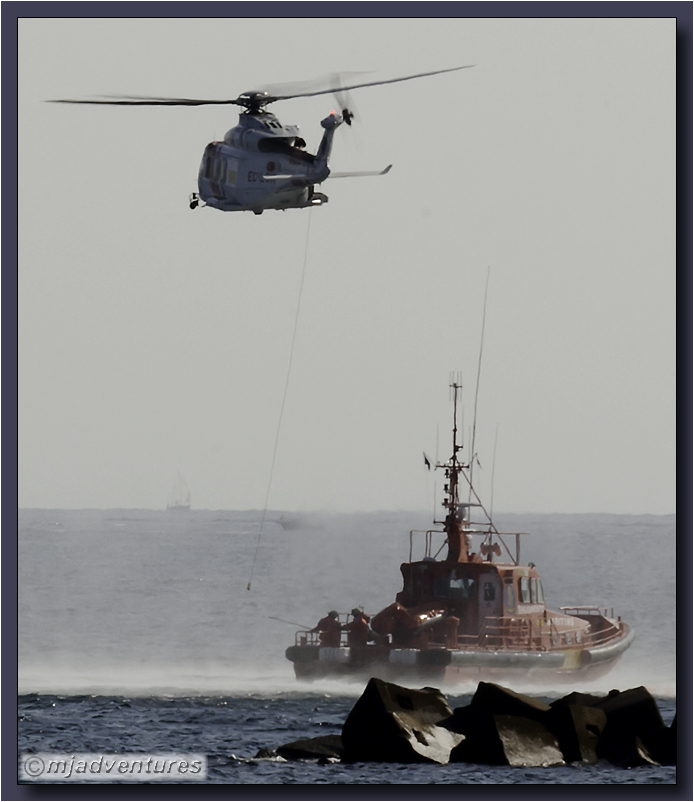
Helicóptero Salvamento Maritimo (Spain's Coastguard), based in Reus, flew in an Agusta Westland 139 to rendezvous with a coastguard vessel. They then demonstrated a personnel transfer between the helicopter and boat. Spain's coastguard helicopters are used for Search and Rescue operations in the Mediterranean, as well as the monitoring and detection of water pollution.
A Puma helicopter from Mallorca's SAR Escuadrón 801 performed a simulated rescue of a man in the water.
Spain's Air Force flew in Patrulla Aspa, or Blade Patrol in English. Using 5 Eurocopter EC120B Colibrí helicopters, the team was formed in 2003 and is based at Armilla. Their display is always a popular one with the spectators and touted to be the best in the world, out of all the helicopter formation teams.
For more posts on the Barcelona Airshow, click on the "Festa al Cel" label below.
Helicóptero Salvamento Maritimo (Spain's Coastguard), based in Reus, flew in an Agusta Westland 139 to rendezvous with a coastguard vessel. They then demonstrated a personnel transfer between the helicopter and boat. Spain's coastguard helicopters are used for Search and Rescue operations in the Mediterranean, as well as the monitoring and detection of water pollution.
A Puma helicopter from Mallorca's SAR Escuadrón 801 performed a simulated rescue of a man in the water.
Spain's Air Force flew in Patrulla Aspa, or Blade Patrol in English. Using 5 Eurocopter EC120B Colibrí helicopters, the team was formed in 2003 and is based at Armilla. Their display is always a popular one with the spectators and touted to be the best in the world, out of all the helicopter formation teams.
For more posts on the Barcelona Airshow, click on the "Festa al Cel" label below.
Labels:
Barcelona,
Catalonia,
Catalunya,
Festa al Cel,
Spain,
Spanish Air Force
26 October 2010
Twister Duo
A brand new acrobatic team showed their wings at this year's Festa al Cel. The UK's Twister Duo uses 2 Silence SA180/SA1100 Twister planes for its aerobatic display. The Silence Twister aircraft is a German design which has been tweaked and modified in order for it to attain UK Group A and aerobatic certification.
The planes are very quiet - hence the "Silence" part in their name - almost too quiet, as they don't announce their arrival like some of the noisier aircraft. However this doesn't detract from the competent and stunning display of synchronised aerobatics that are part of their routine.
As well as the Twister Duo, one of the planes teams up with an S1 Glider and a Cessna tow-plane for a demonstration with a difference.
For more posts on the Barcelona Airshow, click on the "Festa al Cel" label below.
The planes are very quiet - hence the "Silence" part in their name - almost too quiet, as they don't announce their arrival like some of the noisier aircraft. However this doesn't detract from the competent and stunning display of synchronised aerobatics that are part of their routine.
As well as the Twister Duo, one of the planes teams up with an S1 Glider and a Cessna tow-plane for a demonstration with a difference.
For more posts on the Barcelona Airshow, click on the "Festa al Cel" label below.
Labels:
Barcelona,
Catalonia,
Catalunya,
Festa al Cel,
Spain
25 October 2010
Hispano Aviación HA-200 Super Saeta
When I first saw this jet at last year's Festa al Cel, I didn't know what it was. Intensive online research revealed why - it's not an aircraft that was widely flown. The HA-200 Super Saeta was only operated by 2 countries, (Spain and Egypt), and only 200 units were built - 110 for Spain and 90 for Egypt. The Spanish airforce used their planes for both combat and as trainers.
Willie Messerschmidt assisted in the Saeta's design and, in 1962, Spain rolled out its first turbojet manufactured in the country. Saeta means Arrow, and the plane is powered by 2 Turbomeca Marboré engines mounted side-by-side, with intakes in the jet's nose. Another design first for Spain was the development of the pressurised cockpit which seated 2 pilots in tandem.
Festa al Cel featured 2 Saetas in its 2010 display. One is privately owned by Victor Lleó from the Club Acrobático Mediterráneo, and the other is owned by the Fundació Parc Aeronàutic de Catalunya.
For more Barcelona Airshow posts, click on the Label "Festa al Cel" below.
23 October 2010
Planes from Fundació Parc Aeronàutic de Catalunya
With the Fundació Parc Aeronàutic de Catalunya based in Sabadell, just out of Barcelona, (and where some of the visiting planes to Festa al Cel were based for the week), it wasn't surprising that they would parade some of their working exhibits.
Unfortunately, some flew too far off the beach to get decent photos, so I missed getting the older biplanes and the T6 Harvard.
The Fundació's website is merely a placeholder as of now but, hopefully with time, they'll start populating it with information as they do have some wonderful aircraft with local origins.
I'll be covering the Antonov 2R and Saetas in separate posts.
The MBB 233 Flamingo is a rare bird these days. It was built by SIAT (West Germany) in the 1960s in response to demands for an aeroclub training aircraft. In 1970, SIAT was acquired by MMB which was the successor to Messerschmidt. (Willy Messerschmidt was a big influence on the development of planes in this area.) Production was later handed to CASA. In 1986, the Flamingo was the test plane in the development of Porsche's aircraft engine. At present, there are only 2 known MBB Flamingos still flying in the world.
MBB 233 Flamingo
Built in the 60s in Czechoslovakia, the 2-seater Zlin Z-326 Tréner Master was manufactured in large numbers and sold all over Europe. It was one of the most highly successful acrobatic planes ever made, and won many competitions in its era.
Zlin Z-326 Tréner Master
Following on the heels of the Z-326, the Zlin Z-526 Akrobat was developed specifically for acrobatic events. The single-seat plane boasted a 6 cylinder, 160hp inverted engine.
Zlin Z-326 Tréner Master
To read more posts about the Barcelona Airshow, click on the Label "Festa al Cel" below.
21 October 2010
Pioneer Team, Italy
Festa al Cel 2010 had no shortage of formation teams, and one of the cutest (am I allowed to say that about a formation team?) was the Pioneer Team from Italy.
Flying 4 Pioneer 300 propeller planes, they showed that they could mix it with the big boys when it came to formation flying, and gave a very competent and entertaining 10 minute performance.
The Pioneer 300 planes are categorised as "ultralight" aircraft, basically meaning that they are slower and lighter than most other aircraft, are more affordable, and have less restrictions on them than higher performance planes. The restrictions differ from one country to another.
A surprise came with a short pyrotechnic display as the planes each fired off a spray of fireworks.
The finale was a slo-mo dance across the sky, the smoke reflecting the Italian flag colours, with Pavarotti blaring through the PA system - very Italy!
Grazie Pioneer Team!
To read more posts on the Barcelona Airshow, click on the Label "Festa al Cel" below.
Flying 4 Pioneer 300 propeller planes, they showed that they could mix it with the big boys when it came to formation flying, and gave a very competent and entertaining 10 minute performance.
The Pioneer 300 planes are categorised as "ultralight" aircraft, basically meaning that they are slower and lighter than most other aircraft, are more affordable, and have less restrictions on them than higher performance planes. The restrictions differ from one country to another.
A surprise came with a short pyrotechnic display as the planes each fired off a spray of fireworks.
The finale was a slo-mo dance across the sky, the smoke reflecting the Italian flag colours, with Pavarotti blaring through the PA system - very Italy!
Grazie Pioneer Team!
To read more posts on the Barcelona Airshow, click on the Label "Festa al Cel" below.
Labels:
Barcelona,
Catalonia,
Catalunya,
Festa al Cel,
Spain
Subscribe to:
Posts (Atom)